

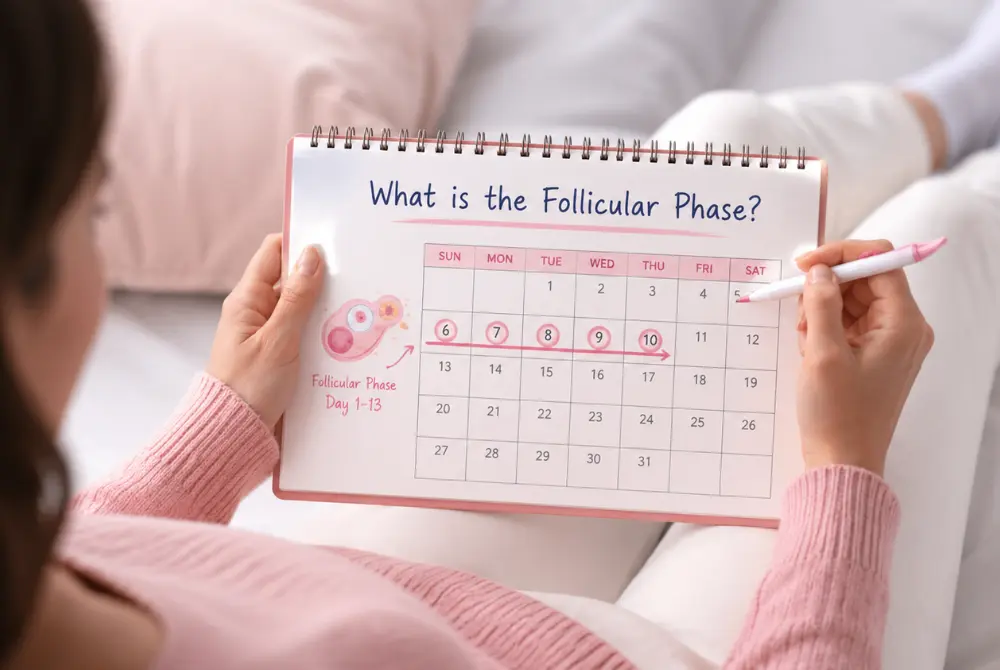
If you have been reading about your menstrual cycle, you may have come across the term ‘follicular phase’ and wondered what it actually means for your body, your energy and your everyday life.
The follicular phase is one of the four stages of the menstrual cycle, and in many ways it is the most transformative. It is the phase in which your body quietly does a remarkable amount of preparation, well before ovulation even happens.
Understanding it more deeply can help you make sense of why you feel the way you do at different points in the month, and how to work with your body rather than against it.
What Are the Four Phases of the Menstrual Cycle?
Before we go deeper on the follicular phase, it helps to see where it fits in the bigger picture.
The four phases of the menstrual cycle are:
- Menstrual phase (Days 1–7) – the period itself
- Follicular phase (Days 1–14) – overlapping with and extending beyond menstruation
- Ovulation (around Day 14) – egg release
- Luteal phase (Days 15–28) – the pre-period phase
The follicular phase actually begins on Day 1 of your cycle, the same day as your period, and runs until ovulation. So while you are still bleeding, the follicular phase has already begun. Many people do not realise this.
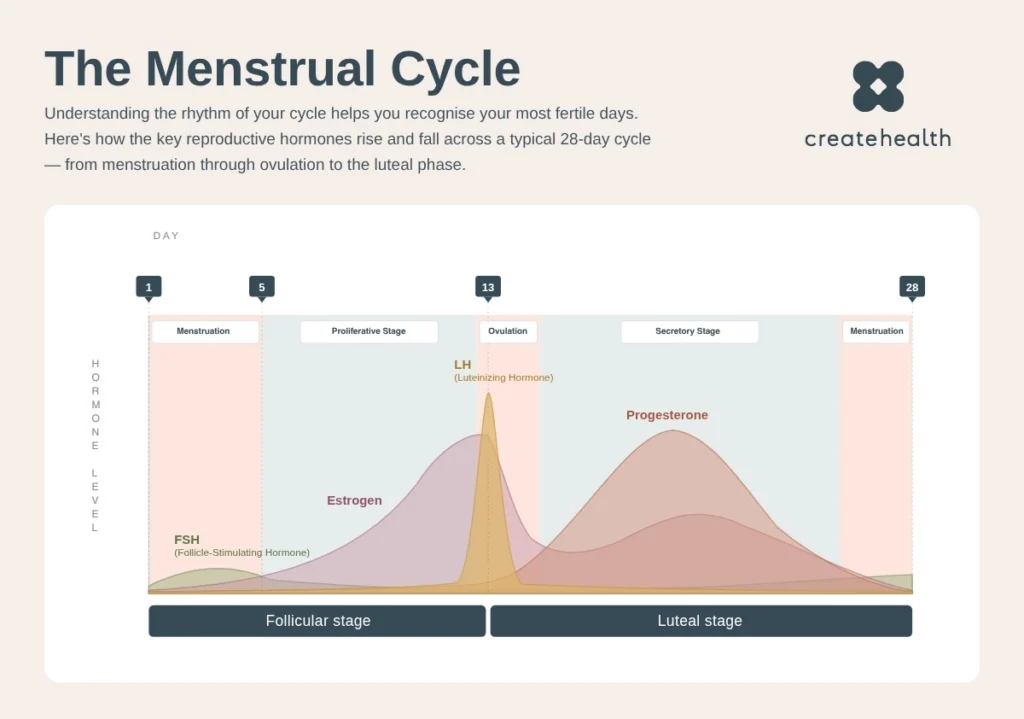
Here is how the follicular phase fits into your full cycle:
What is the Follicular Phase?
The follicular phase is the part of your menstrual cycle in which follicles inside your ovaries develop and mature in preparation for ovulation.
Each follicle is a small fluid-filled sac containing an egg. At the start of your cycle, a hormone called follicle stimulating hormone (FSH) is released by the brain and signals the ovaries to begin developing a group of these follicles. Over the course of the follicular phase, one follicle becomes dominant and grows larger than the rest. This dominant follicle produces increasing amounts of oestrogen as it matures.
That rise in oestrogen is what drives many of the changes you may notice in your body, your mood and your energy during this phase.
At the end of the follicular phase, a surge in luteinising hormone (LH) triggers ovulation, releasing the mature egg from the dominant follicle. This marks the transition into the next phase of the cycle.
How Long is the Follicular Phase? (Days 1–14)
The follicular phase typically lasts around 14 days in a 28-day cycle, though this is an average rather than a rule.
The length of the follicular phase is actually the most variable part of the menstrual cycle. The luteal phase (after ovulation) is relatively consistent at around 14 days for most women. The follicular phase, however, can range from as few as 9 or 10 days to 20 or more, which is one reason cycle length varies so much between individuals and even from month to month for the same person.
A shorter follicular phase means ovulation happens earlier in the cycle. A longer one means it happens later. Factors like stress, illness, significant weight changes and thyroid function can all affect how long this phase lasts.
What Happens During the Follicular Phase? (The Science, Simply Explained)
Here is what is happening inside your body during this phase, step by step.
Days 1–5 (overlapping with menstruation): The brain signals the pituitary gland to release FSH. This stimulates a group of follicles in the ovaries to begin developing. While you may be focusing on your period, the next cycle is already starting to take shape.
Days 6–10: One follicle becomes dominant and begins to outgrow the others. The others gradually stop developing. The dominant follicle produces increasing amounts of oestrogen, which begins to thicken the uterine lining in preparation for a potential pregnancy.
Days 10–14: Oestrogen continues to rise, peaking in the days just before ovulation. This hormonal surge triggers a sharp increase in LH (the luteinising hormone surge), which causes the dominant follicle to rupture and release its egg. Ovulation has arrived.
Follicular Phase Symptoms — What Does It Feel Like? (Days 1–14)
Some women can feel the follicular phase distinctively, particularly in the second half of it once menstruation has ended and oestrogen is climbing.
Common follicular phase symptoms and experiences include:
- A gradual return of energy as the phase progresses
- Improved mood and emotional steadiness
- Sharper mental focus and motivation
- Reduced bloating compared to the luteal phase
- Clearer or brighter skin for some women
- Changes in cervical mucus, becoming clearer, more slippery, and stretchy as ovulation approaches
- A general sense of feeling ‘back to yourself’ after the period
These changes are driven by rising oestrogen, which has a broadly positive effect on mood, energy and physical wellbeing for most women. It supports the production of serotonin, which is part of why many people notice an emotional lift during this time.
Not everyone notices these changes distinctly, and that is completely normal. Cycle experiences vary between people and from month to month.
Follicular Phase and Energy Levels (What to Expect)
The link between the follicular phase and energy is one of the most well-documented aspects of cycle-based wellbeing.
As oestrogen rises through the follicular phase, energy typically rebuilds after the lower levels many women experience during menstruation. By the time you approach ovulation, many women describe feeling their most energetic, focused and socially confident of the month.
In practical terms, many women find the follicular phase a good time for:
- Higher-intensity or strength-based exercise, as the body tends to tolerate physical demands well
- Starting new projects or tackling challenging tasks, when mental clarity tends to be sharper
- Social plans and commitments, when energy for connection is often higher
- Creative work, which many women find flows more easily during this phase
This does not mean every woman feels this way, or that the pattern holds every month. Stress, sleep, illness, and many other factors interact with your hormonal cycle. But understanding the general pattern can help you notice your own rhythm.
“When my patients start tracking their cycle, they are often surprised by how much it explains – their energy, their mood, their motivation. It is not ‘just hormones’, it is information.” – Dr Sugandha Kumar, Obstetrician and Gynaecologist, Melbourne
The Follicular Phase and Your Fertile Window (What You Need to Know)
The end of the follicular phase is when you are most fertile.
In the days leading up to ovulation, cervical mucus changes to become more clear, slippery, and stretchy, resembling raw egg white. This is a sign that the fertile window is opening. Sperm can survive inside the body for up to five days, which means having sex in the days before ovulation can still result in pregnancy once the egg is released.
Your fertile window typically spans the five days before ovulation and the day of ovulation itself. Because the follicular phase length varies, the timing of ovulation is not always predictable from a calendar alone. Tracking cervical mucus changes, basal body temperature, or using an ovulation predictor kit can give you more reliable information about where you are in your cycle.
If you are trying to conceive, understanding the follicular phase and recognising the signs that ovulation is approaching is one of the most useful things you can do.
Follicular Phase Pain – Is It Normal? (When to Pay Attention)
Most women move through the follicular phase without significant discomfort. Some, however, experience mild pelvic discomfort as follicles develop and oestrogen rises.
As ovulation approaches, some women feel a sharp twinge or cramping sensation on one side of the lower abdomen. This is known as Mittelschmerz, a German word meaning “middle pain”, and it is caused by the release of the egg from the follicle. It is usually brief, lasting from a few minutes to a few hours, and is considered a normal variation.
Mild discomfort during the follicular phase is generally not a cause for concern. However, persistent, severe, or worsening pelvic pain at any point in your cycle should be discussed with a doctor. It can sometimes be a sign of conditions such as endometriosis, ovarian cysts, or other gynaecological conditions that are worth investigating.
What is a Short Follicular Phase? (When It Matters)
A short follicular phase, generally considered to be fewer than 10 days, means ovulation occurs earlier than average in the cycle.
This can happen naturally, and for some women it is simply their normal. But a consistently short follicular phase can also be associated with:
- Approaching perimenopause, when FSH levels begin to rise and follicles develop more quickly
- Low ovarian reserve, where fewer follicles are available and the dominant one develops faster
- High stress levels, which can affect the hormonal signals involved in follicle development
- Low body weight or significant nutritional deficiency
- Thyroid dysfunction
A short follicular phase can affect fertility if the egg is released before it has had adequate time to fully mature, or if the uterine lining has not had sufficient time to thicken. If you are tracking your cycle and noticing a consistently short follicular phase, it is worth raising with your gynaecologist, particularly if you are trying to conceive.
What is a Long Follicular Phase?
A longer than average follicular phase means it is taking more time for a dominant follicle to develop and trigger ovulation. This pushes ovulation later in the cycle and extends the cycle overall.
A long follicular phase can occur in response to stress, illness, or significant life changes. In women with PMOS (previously known as PCOS), the follicles often fail to develop fully and ovulation may be delayed or absent altogether, which is one of the most common reasons for irregular cycles.
A long follicular phase on occasion is usually not a cause for concern. When cycles are consistently long or irregular, and particularly when this is associated with other symptoms, a specialist assessment is worthwhile.
The Follicular Phase and Your Skin, Sleep, and Mood (The Wider Picture)
Oestrogen’s influence extends well beyond the reproductive system, and many women notice its rise in the follicular phase across several areas of their lives.
Skin: Rising oestrogen supports collagen production and skin hydration. Many women notice their skin looks and feels clearer or more even-toned during the follicular phase compared to the days before their period.
Sleep: Sleep quality often improves during the follicular phase. Oestrogen has a broadly positive effect on sleep architecture, and many women find it easier to fall and stay asleep during this part of the cycle compared to the premenstrual phase.
Mood and cognition: Oestrogen supports serotonin and dopamine activity, which is reflected in the mood lift and cognitive sharpness many women notice as the follicular phase progresses. Memory, verbal fluency, and processing speed have all been studied in relation to the oestrogen cycle, with some research suggesting improvements during the follicular phase.
Libido: Interest in sex often increases as ovulation approaches, which is consistent with the biological purpose of the cycle.
Tracking Your Follicular Phase (A Practical Starting Point)
You do not need a complex system to start tuning into your follicular phase. Even basic tracking can help you recognise patterns over time.
Things worth tracking include:
- The first day of your period (Day 1 of the cycle)
- Your energy and mood each day on a simple scale
- Changes in cervical mucus, particularly the transition to clear and stretchy mucus that signals approaching ovulation
- Any pelvic pain or discomfort and when in the cycle it occurs
- Sleep quality and physical wellbeing
Over three to six months, you will begin to see your own cycle pattern clearly, including roughly when your follicular phase tends to end and ovulation tends to occur.
Many period tracking apps can help with this, though basal body temperature tracking and cervical mucus observation remain some of the more reliable methods for identifying ovulation.
When to See a Specialist (Follicular Phase and Cycle Health)
Understanding your follicular phase can help you notice when something does not feel right. It is worth speaking with a gynaecologist or women’s health specialist if:
- Your cycles are consistently shorter than 21 days or longer than 35 days
- You are tracking your cycle and cannot identify an ovulation pattern
- You experience significant pain during the follicular phase or around ovulation
- You have been trying to conceive for several months without success
- You notice very irregular cycles that are difficult to predict
- You have symptoms that could suggest PMOS, endometriosis, or another underlying condition
Our Women’s Health team at Create Health is here to help you understand your cycle and what it might be telling you.
Who Can I Talk To for Advice?
Our Women’s Health specialists at Create Health are always available for advice and would love to listen and discuss how we can help. We are experts in this area and are here to support you.
Contact us by ringing (03) 9873 6767 or by writing to info@create-health.com.au.
Frequently Asked Questions
How do you feel during the follicular phase?
Most women notice a gradual return of energy, improved mood, and sharper focus as oestrogen rises through the follicular phase. It is often described as the most positive stretch of the cycle, with many women feeling more motivated, sociable, and physically capable than in the days before or during their period. That said, experiences vary, and not everyone notices these shifts in a pronounced way.
Can I get pregnant during the follicular phase?
Yes, particularly in the days leading up to ovulation, which marks the end of the follicular phase. Sperm can survive in the body for up to five days, so having sex in the final days of your follicular phase can result in pregnancy once ovulation occurs. The closer you are to ovulation, the higher the chance of conception.
What causes a short follicular phase?
A short follicular phase (under around 10 days) can occur naturally for some women, but it is also associated with approaching perimenopause, low ovarian reserve, high stress, low body weight, and thyroid dysfunction. If you are consistently ovulating very early in your cycle and are trying to conceive, it is worth discussing with a specialist.
Is it normal to feel pain during the follicular phase?
Mild pelvic discomfort during follicle development are common. A short, sharp twinge or cramp on one side of the lower abdomen around the time of ovulation, known as Mittelschmerz, is also a normal variation. Persistent or severe pain should always be checked by a doctor, as it can sometimes indicate conditions such as endometriosis or ovarian cysts.
What is the difference between the follicular phase and ovulation?
The follicular phase is the preparation stage: follicles develop, oestrogen rises, and the uterine lining thickens. Ovulation is the event that ends the follicular phase, when the dominant follicle ruptures and releases its egg. Ovulation is a single event (or a brief window of hours), while the follicular phase is a process lasting up to two weeks.
What is the best type of exercise during the follicular phase?
As energy and oestrogen rise through the follicular phase, many women find this a good time for higher-intensity or strength-based training. Research suggests muscle strength and recovery may be at their best around this time. That said, the most important thing is to listen to your own body, since energy levels vary between individuals and from cycle to cycle.
What does it mean if I have a long follicular phase?
A longer follicular phase means ovulation is delayed, which extends the overall cycle. This can happen in response to stress, illness, or significant life changes. In women with PMOS, follicles often fail to progress normally and ovulation may be significantly delayed or absent. Consistently long or irregular cycles are worth discussing with a specialist, particularly if you are trying to conceive.
How does the follicular phase affect fertility?
The follicular phase is central to fertility. It is the period in which the egg matures and the uterine lining prepares to receive a fertilised egg. A well-functioning follicular phase with a mature, healthy dominant follicle is essential for natural conception. Problems with follicle development, a very short or very long follicular phase, or absent ovulation can all affect fertility and are assessed as part of a specialist fertility workup.
Key Takes
- The follicular phase runs from Day 1 of your cycle (the start of your period) until ovulation, typically around Day 14 in a 28-day cycle.
- It is the most variable phase of the cycle. Its length determines when ovulation occurs and why cycle lengths differ so much between women.
- During this phase, FSH signals the ovaries to develop follicles. One becomes dominant and produces rising oestrogen, which drives many of the positive changes women notice in this part of the cycle.
- Rising oestrogen typically brings improved energy, mood, mental focus, and physical wellbeing, particularly in the second half of the follicular phase.
- The end of the follicular phase is your fertile window. Cervical mucus changes to become clearer and more slippery as ovulation approaches.
- Mild pelvic discomfort and ovulation pain (Mittelschmerz) can be normal. Persistent or severe pain should always be assessed by a doctor.
- A consistently short follicular phase may be linked to low ovarian reserve or perimenopause. A consistently long one may suggest PMOS or other hormonal factors.
- Tracking your cycle, including energy, cervical mucus, and mood, over several months can reveal your personal pattern and help you understand your body more deeply.
- If you have concerns about your cycle length, ovulation, or fertility, our team at Create Health is here to help.
References
https://www.ncbi.nlm.nih.gov/books/NBK542229/
https://www.ncbi.nlm.nih.gov/books/NBK535442/
https://my.clevelandclinic.org/health/body/23953-follicular-phase
https://www.sciencedirect.com/topics/biochemistry-genetics-and-molecular-biology/follicular-phase
https://link.springer.com/article/10.1007/s43032-024-01740-3
https://pmc.ncbi.nlm.nih.gov/articles/PMC7916245/
https://shvic.org.au/for-you/reproductive-and-sexual-health/menstrual-cycle
https://www.create-health.com.au/blog/menstrual-cycle-understanding-and-celebrating-you/